

Data centers are the beating heart of the modern digital economy, operating around the clock to support cloud computing, artificial intelligence, and global telecommunications. However, maintaining continuous uptime while simultaneously managing massive power and cooling loads requires sophisticated oversight. Enter the modern scada data center. By utilizing Supervisory Control and Data Acquisition methodologies, facility managers can achieve unprecedented operational visibility and granular control over their most critical assets.
While traditionally rooted in manufacturing plants and utility grids, SCADA systems have become absolutely indispensable in massive data facilities. They act as the central nervous system of operations, transforming raw sensor data from across the server floor into actionable intelligence. This article explores highly effective strategies for optimizing a SCADA data center, outlining best practices for hardware integration, energy management, alarm configuration, and proactive cybersecurity.
Supervisory Control Systems are the Backbone of Operational Visibility
At its core, a robust supervisory control system architecture relies on a centralized computer network that continuously gathers, aggregates, and analyzes real-time data from localized physical equipment. In the context of a mission-critical facility, this architecture effectively bridges the complex gap between sensitive IT hardware and heavy facility mechanics.
By adopting advanced critical infrastructure management systems, operators gain comprehensive, holistic oversight of both electrical and mechanical workflows. This modern approach borrows heavily from the best practices of industrial automation, treating the entire facility as a highly synchronized machine rather than a fragmented collection of independent server racks. The optimization of this underlying architecture dictates exactly how efficiently a facility operates under varying IT loads, making these foundational design choices absolutely crucial for long-term scalability and success.
Core Components From Edge to Screen
Achieving reliable facility performance starts with a strong edge hardware foundation. Accurate and dependable data collection is built on seamless integration with programmable logic controllers (PLCs). These controllers serve as the critical digital interface between physical equipment, including commercial chillers, backup generators, and UPS battery systems, and centralized monitoring platforms. By enabling real-time data exchange and control, PLCs provide the intelligence needed for efficient system operation. When properly integrated, they execute high-speed, localized control logic that maintains safe and reliable equipment performance, even during temporary interruptions in network communications.
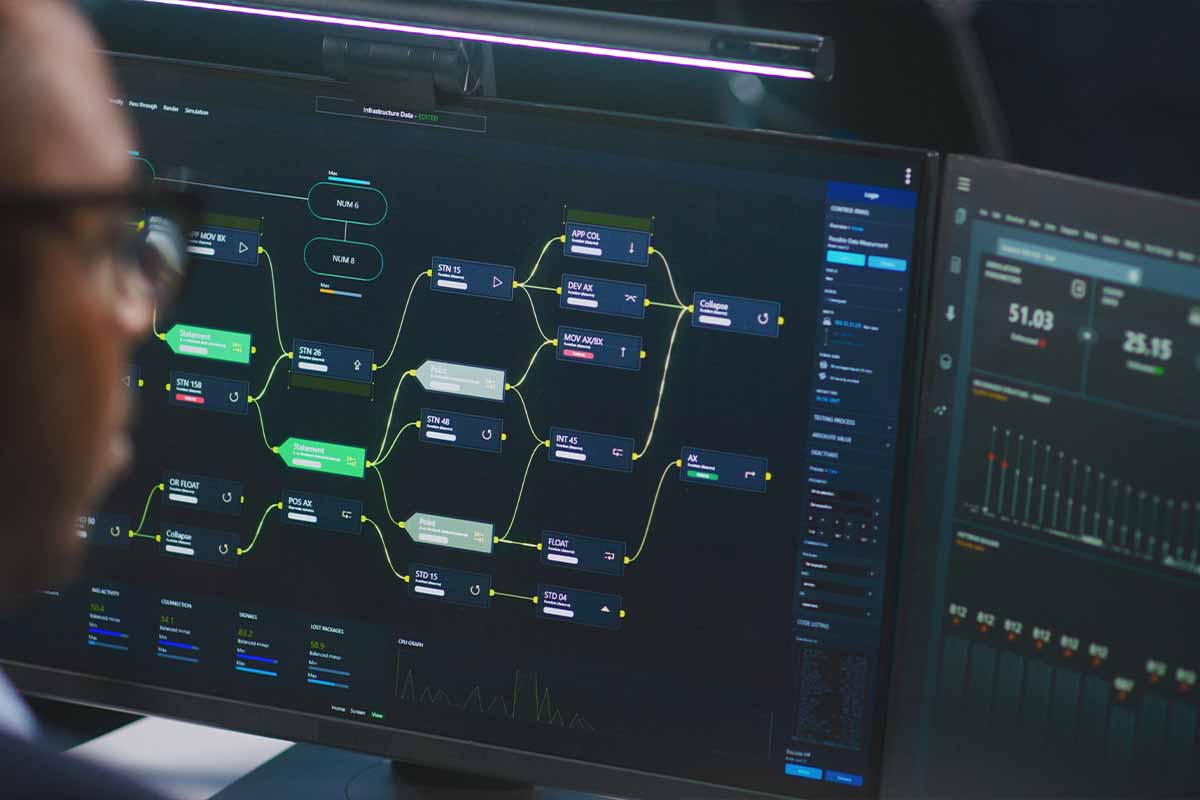
However, the vast amounts of data collected by these edge PLCs are only useful if facility engineers can interpret them quickly and accurately. This is exactly where intuitive human machine interface dashboard design becomes vital. A poorly designed, cluttered HMI inevitably leads to operator fatigue, confusion, and delayed response times during an emergency. The most effective HMIs prioritize contextual information, utilizing color-coded network topologies, dark-mode options for low-light operations, and hierarchical navigation to highlight critical metrics at a glance. Together, optimized edge controllers and expertly crafted HMIs function as incredibly powerful real-time facility monitoring tools, ensuring operators can instantly assess system health and respond to anomalies before they escalate.
SCADA Systems and Raised Access Floors: Powering Reliable Data Centers
SCADA (Supervisory Control and Data Acquisition) systems play a critical role in monitoring and managing data center infrastructure, providing real-time visibility into power, cooling, and environmental conditions. Raised access flooring complements these systems by creating an underfloor space for organized routing of power, data cabling, and conditioned airflow. Together, SCADA technology and raised floor systems help improve operational efficiency, simplify maintenance, and support the high levels of reliability and uptime required in modern data centers.
What is SCADA? Communication Protocols and Software Integration
SCADA (Supervisory Control and Data Acquisition) is a highly functioning facility relies on uninterrupted, high-speed communication between highly diverse pieces of hardware. Comparing remote monitoring protocols is a fundamental step in optimizing any greenfield or brownfield deployment. Typically, facility managers rely heavily on standard modbus and bacnet communication protocols. Modbus remains highly favored for its distinct simplicity and reliability when querying smart power meters and edge PLCs. Conversely, BACnet is generally the recognized standard for governing complex HVAC systems and liquid cooling loops. Translating between these distinct protocols seamlessly within the central server is essential for generating a unified, accurate operational picture.
As facilities grow, operational leaders often wonder about SCADA vs DCIM software differences and how the two interact. While Data Center Infrastructure Management (DCIM) tools excel at IT asset tracking, server lifecycle management, and rack-level capacity planning, SCADA provides superior, low-latency control over heavy facility machinery. Optimizing overall facility performance often means bridging the two: using SCADA solution to actively govern the mechanical and electrical plant, while automatically feeding summarized power and thermal metrics into the DCIM platform for accurate IT provisioning.
What are Strategies for Maximizing Efficiency and Uptime in SCADA Systems?
One of the most frequent questions from facility stakeholders and financial officers is: How does SCADA improve energy efficiency?
The answer lies in continuous granular data analysis combined with automated, real-time adjustments. By continuously monitoring environmental parameters across the entire server floor, the system can dynamically adjust energy-heavy mechanical equipment to match the exact IT load at any given moment.
A primary example of this concept in action is optimizing data center cooling cycles. Instead of running computer room air conditioning (CRAC) units at a rigid, static setpoint, advanced control algorithms can continuously vary fan speeds, adjust floor dampers, and regulate chilled water flows based on real-time thermal readings from specific cold aisles. This highly targeted approach prevents wasteful overcooling, reclaims stranded capacity, and significantly reduces overall facility power consumption, directly lowering the Power Usage Effectiveness (PUE) ratio.
Equally important to active temperature management is rigorous electrical oversight. Diligently monitoring power distribution units (PDUs) ensures that electrical loads remain perfectly balanced across different phases and circuits. If a specific rack density increases and draws excess power, operators receive immediate notifications, allowing them to shift virtual workloads or physically provision additional circuit capacity. Ultimately, mastering these intertwined cooling and electrical metrics is the absolute most effective strategy for preventing server room downtime, ensuring that the physical environment never becomes the bottleneck for continuous IT availability.
Automating the Environment and Streamlining Alarms
Optimization goes far beyond passive observation; it requires active, intelligent management. Implementing automated environmental controls allows the facility to self-correct minor deviations without requiring human intervention. For instance, if air humidity drops below an acceptable safety threshold in a specific containment aisle, the system can automatically command localized ultrasonic humidifiers to activate, disengaging them the moment optimal static levels are smoothly restored.
However, when automated controls cannot resolve a sudden mechanical issue, the system must immediately alert human operators. This requires meticulously configuring site alarm management workflows. Alarm fatigue is a severe, recognized risk in any scada data center; if every minor temperature fluctuation triggers a blaring siren, operators will eventually become desensitized and ignore critical warnings.
How do you optimize alarm management workflows effectively in a SCADA system?
- Categorize by Strict Severity: Classify alarms into definitive priority tiers (e.g., Critical, Warning, Informational). Only critical issues, such as a primary utility failure, should trigger immediate SMS, email, or pager alerts to on-call staff.
- Implement Smart Delay Timers: Prevent transient data spikes (like a brief temperature fluctuation caused by a technician opening a containment door) from triggering nuisance alarms.
- Group Related Cascade Events: If a main distribution breaker trips, configure the system to suppress the resulting hundreds of downstream low-voltage alarms, preventing a chaotic cascade of redundant notifications.
- Require Manual Acknowledgements: Ensure that high-priority security and power alerts require a manual, logged operator sign-off, leaving a clear audit trail for later post-incident review.
Fortifying Against Modern Cyber Threats
As operational technology networks increasingly converge with traditional corporate IT networks, cybersecurity becomes a paramount, non-negotiable concern. When optimizing your foundational infrastructure, security teams must proactively ask: what are common industrial control vulnerabilities?
Historically, facility control systems were entirely air-gapped, meaning they had absolutely no connection to the outside internet. Today, the intense demand for remote visibility and cloud analytics has introduced vast new attack vectors. Common vulnerabilities include outdated legacy protocols transmitting data in plaintext, unpatched PLC firmware, open firewall ports, and weak default passwords left on network edge switches.
Securing a modern scada data center demands a rigorous defense-in-depth strategy. Facility operators must implement strict network segmentation, utilizing industrial firewalls to securely isolate the sensitive control network from the general corporate IT LAN. Additionally, deploying modern anomaly detection software can swiftly identify unauthorized access attempts, spoofed credentials, or suspicious logic commands sent to critical mechanical hardware. Regular vulnerability assessments, encrypted VPN access for remote vendors, and strict multi-factor authentication are no longer optional—they are absolutely foundational to maintaining total, uninterrupted system integrity.
SCADA System Conclusion
In an era where digital continuity is synonymous with overall business survival, the underlying physical infrastructure must be resilient, highly intelligent, and effortlessly adaptable. Optimizing a SCADA environment is not a one-time project, but an ongoing operational journey of continuous refinement.
From carefully selecting the right high-speed communication protocols and designing intuitive, operator-friendly HMIs, to dynamically automating environmental responses and heavily fortifying network security, every granular improvement compounds into massive long-term gains in efficiency and reliability. By treating the facility as a deeply interconnected ecosystem rather than a collection of separate parts, operators can finally unlock true operational excellence. Leveraging these advanced monitoring and control strategies seamlessly bridges the gap between raw mechanical power and digital performance, ensuring your facility is fully prepared to handle the relentless demands of tomorrow’s technological landscape.