

A reliable data center depends on much more than servers and networking equipment. Power distribution, cooling infrastructure, raised flooring, airflow management, racks, cable pathways, physical security, monitoring systems, and other supporting components work together to create the environment in which IT equipment can operate.
The components required—and how they’re specified—depend heavily on whether a facility is being designed from the ground up, expanded, remodeled, or maintained as an existing operational data center. New construction provides opportunities to coordinate infrastructure from the beginning, while existing facilities must often integrate new equipment with legacy systems and physical constraints.
DCFT works primarily with the physical infrastructure layer, including raised access flooring, airflow products, containment, replacement components, and related products for new and existing data center environments.
TL;DR – Essential Data Center Components
- Data centers rely on interconnected power, cooling, flooring, airflow, cabling, racks, security, monitoring, and IT infrastructure rather than any single component.
- New construction allows these systems to be coordinated from the design stage, while remodels must account for existing equipment, legacy infrastructure, physical constraints, and potential operational disruption.
- Raised access floors can support equipment, cable distribution, underfloor infrastructure, and airflow where the cooling design uses an underfloor plenum.
- Component selection should account for current requirements as well as maintenance, replacement availability, future equipment density, and facility expansion.
What Are the Essential Components of a Data Center?
Power Distribution and Backup Power
At a high level, this layer includes utility service, UPS systems, backup generation, power distribution equipment, and rack-level power delivery, typically with redundancy built in to protect against outages. Power infrastructure must be coordinated with equipment density, cooling requirements, rack layouts, redundancy goals, and the physical space available throughout the facility.
Cooling and Thermal Management
Cooling covers heat removal from the room and from individual racks, spanning conventional air cooling, liquid cooling in higher-density environments, and the airflow management and containment strategies that tie them together. Not every modern facility uses the same cooling architecture—many now combine air and liquid cooling as rack densities climb beyond what conventional underfloor air distribution can handle on its own, and the right mix depends entirely on the equipment being cooled.
Raised Access Flooring
Raised access flooring can play a broader infrastructure role than its visible surface suggests. A raised access floor system can provide structural support for equipment, accessible underfloor pathways for power and data routing, flexible equipment layouts as the facility changes, underfloor air distribution where the cooling design calls for it, and replaceable, modular panels that simplify long-term maintenance.
Pro Insight: Flooring Is Infrastructure, Not Just a Finish. Raised flooring in a data center should be evaluated as part of the facility’s infrastructure. Panel load ratings, understructure, finished floor height, equipment movement, cable pathways, and airflow requirements can all affect system selection.
Airflow Panels and Grates
In facilities using underfloor air distribution, perforated panels and high-flow floor tiles deliver conditioned air from the plenum to rack intakes. More open area doesn’t automatically mean better cooling—the airflow product needs to match the mechanical design, including available static pressure and rack demand, rather than being chosen for the highest airflow rating alone.
Server Racks and Cabinets
Racks and cabinets support IT equipment directly, but they also interact constantly with the infrastructure around them—the floor loads they create, the airflow patterns they depend on, the cable routing beneath and around them, and the containment strategy that keeps their exhaust separated from supply air. Equipment moves affect all of these at once, which is part of why floor and rack planning shouldn’t happen independently.
Cable Management Infrastructure
Power, data, and fiber cabling typically run through some combination of overhead trays and underfloor pathways, with grommets controlling penetrations through the floor. Proper separation, accessibility, and reserved capacity for future additions all matter more over time than they do on day one, as unmanaged cabling tends to accumulate and complicate both airflow and maintenance.
Aisle Containment
Hot-aisle and cold-aisle containment systems separate supply and return airflow to improve cooling efficiency, and they’re a common part of airflow management in facilities using underfloor air distribution. Not every facility needs the same containment configuration—the right approach depends on rack density, layout, and the broader cooling strategy.
Physical Security and Access Control
Security cages, restricted-access areas, surveillance systems, and controlled entry points help protect equipment and limit access to sensitive infrastructure. Physical security requirements should be coordinated with equipment layouts, maintenance access, emergency procedures, and the facility’s broader security policies.
Monitoring and Management Systems
Environmental and infrastructure monitoring helps facility teams track conditions such as temperature, humidity, power, and equipment status. Early visibility into changing conditions can help operators identify developing infrastructure problems before they affect critical equipment.
How Data Center Component Requirements Change by Project Type
Existing Data Centers
Existing facilities have to work around infrastructure that’s already installed—legacy raised flooring, existing power and cooling capacity, current cabling, and current equipment loads—all while maintaining operational continuity within limited physical space. Replacement compatibility becomes a central concern in a way it simply isn’t for new construction.
Pro Insight: Document Existing Infrastructure Before Planning Upgrades. Older facilities may contain flooring, understructure, airflow products, or other components that are no longer manufactured. Identify existing manufacturers, product models, specifications, and replacement availability before assuming new components can be integrated directly.
Where a legacy raised floor system is involved, identifying the original raised floor manufacturer and product family is often the fastest path to understanding what replacement options actually exist.
Data Center Remodels and Retrofits
A remodel goes beyond routine maintenance—it may involve higher-density racks, cooling changes, new cable pathways, reconfigured floor layouts, containment additions, replacement flooring, new airflow components, or equipment relocation. The central challenge is integration: new infrastructure has to work with whatever remains, not replace it wholesale. Where ceiling height or structural conditions limit a full-height floor replacement, a low-profile raised floor system can sometimes provide accessible cable and service distribution without the clearance a traditional plenum would require—though it’s one option among several, not a default retrofit solution.
New Data Center Construction
New construction gives project teams the opportunity to coordinate structural loads, floor heights, rack layouts, power, cooling, cable distribution, containment, and future expansion from the start, rather than working around existing constraints. Getting the raised access floor installation planned correctly alongside these other systems—rather than as an afterthought once other infrastructure is already designed—makes that coordination considerably easier to execute.
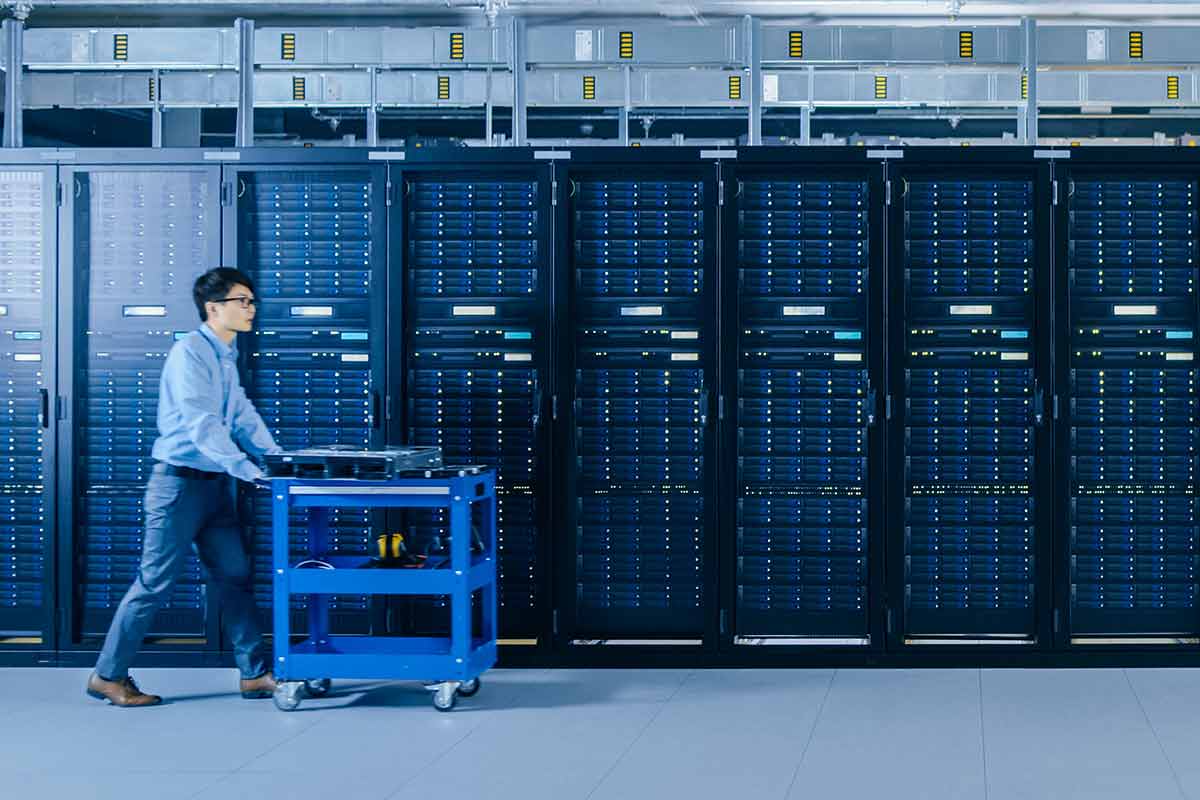
Data Center Components for Airflow and Cooling
In facilities using underfloor air distribution, several components work together in sequence: the raised floor creates the plenum, airflow panels or grates deliver conditioned air into the room, that air reaches rack intakes, containment keeps it separated from exhaust air, and a return path carries warm air back to the cooling system. Selecting between perforated panels and air grates for air delivery depends on the cooling demand in a particular zone, available static pressure, rack requirements, and the broader mechanical design rather than a single facility-wide standard.
Newer facilities increasingly rely on hybrid cooling, direct-to-chip liquid cooling, or other architectures where raised-floor airflow serves only part of the equipment in the room—the floor’s role shifts rather than disappears in these designs, continuing to handle infrastructure that doesn’t require liquid cooling.
Pro Insight: More Airflow Isn’t Automatically Better. Installing a higher-open-area floor panel doesn’t guarantee better cooling. Airflow products should be selected according to available static pressure, rack requirements, containment strategy, equipment placement, and the broader mechanical design.
Raised Floor Components That Support Data Center Infrastructure
Solid Floor Panels
Solid floor panels make up most of the data hall floor, providing structural support and helping maintain plenum pressure in facilities using underfloor air distribution. New and replacement raised floor panels are available in several materials and load ratings depending on the application.
Perforated and High-Flow Panels
Perforated and high-flow panels deliver conditioned air from the underfloor plenum where required by the facility’s mechanical design. Panel selection should account for airflow requirements, available static pressure, rack density, and equipment placement.
Pedestals and Stringers
Pedestals and stringers form the supporting understructure beneath the panels, helping establish finished floor height, stability, and load capacity while creating accessible space for underfloor infrastructure.
Grommets and Floor Penetrations
Grommets help organize cable penetrations through the raised floor while reducing unnecessary open space around power and communications cabling.
Panel Lifters and Maintenance Accessories
Panel lifters and related maintenance accessories provide safe, routine access to the underfloor space without relying on improvised removal methods that can damage panels or finishes.
Planning for Maintenance and Replacement
Infrastructure design shouldn’t stop at installation. Facilities should think ahead about replacement availability, spare panels, which components are truly critical, manufacturer and product documentation, legacy compatibility, lead times, and how much onsite inventory actually makes sense for their situation.
For a deeper look at replacement planning, see our guide to data center spare parts and replacement components, which covers how to identify existing systems and evaluate new, refurbished, and legacy replacement options.
Planning Data Center Components for Future Growth
Data center requirements rarely stay fixed for long. Rack densities tend to increase, equipment changes, additional cabling gets added, cooling strategies evolve, and layouts get reconfigured as facilities expand. Components specified with only current requirements in mind can become a constraint sooner than expected, which is why modularity and long-term maintainability matter as much as any single product’s specifications on the day it’s installed.
Planning for future growth doesn’t require predicting every technology change. It means avoiding infrastructure decisions that unnecessarily restrict future equipment, cooling, cabling, or layout options.
Frequently Asked Questions About Data Center Components
What are the main components of a data center?
Data centers typically combine power and backup systems, cooling infrastructure, racks and cabinets, networking and IT equipment, cable-management systems, physical security, monitoring systems, and supporting physical infrastructure such as raised flooring where required by the facility design.
Why are raised floors used in data centers?
Raised access floors can provide structural support for equipment while creating accessible space for cabling, power, and other infrastructure. In facilities using underfloor air distribution, the space beneath the floor may also function as an air-delivery plenum.
Do all data centers need raised access flooring?
No. Raised flooring should be selected according to the facility’s infrastructure, equipment, cable-management, structural, and cooling requirements. Some facilities benefit substantially from raised floors, while others use slab-based or alternative designs.
How are data center remodels different from new construction?
New construction allows infrastructure systems to be coordinated from the beginning. Remodels and retrofits must integrate new components with existing flooring, power, cooling, cabling, equipment, and physical constraints while often minimizing disruption to ongoing operations.
What data center components should be kept as spare parts?
Spare-parts requirements depend on operational impact, replacement lead time, component availability, and the existing infrastructure. Raised floor panels, airflow products, understructure components, grommets, and maintenance accessories are among the physical infrastructure products facilities may consider keeping available.
Final Thoughts
The components of a data center function as an interconnected infrastructure system. Power, cooling, flooring, airflow, cabling, racks, security, and monitoring requirements need to be evaluated together rather than specified independently.
For existing facilities and remodels, compatibility with installed infrastructure can be just as important as the capabilities of new products. For new construction, early coordination can help create an environment that remains accessible, maintainable, and adaptable as equipment requirements change.
Planning a Data Center Build, Remodel, or Infrastructure Upgrade?
DCFT can help evaluate raised access flooring, airflow products, replacement panels, understructure, containment, and related physical infrastructure for new and existing data center environments.